
Internet in Thailand 2026: how travellers stay online
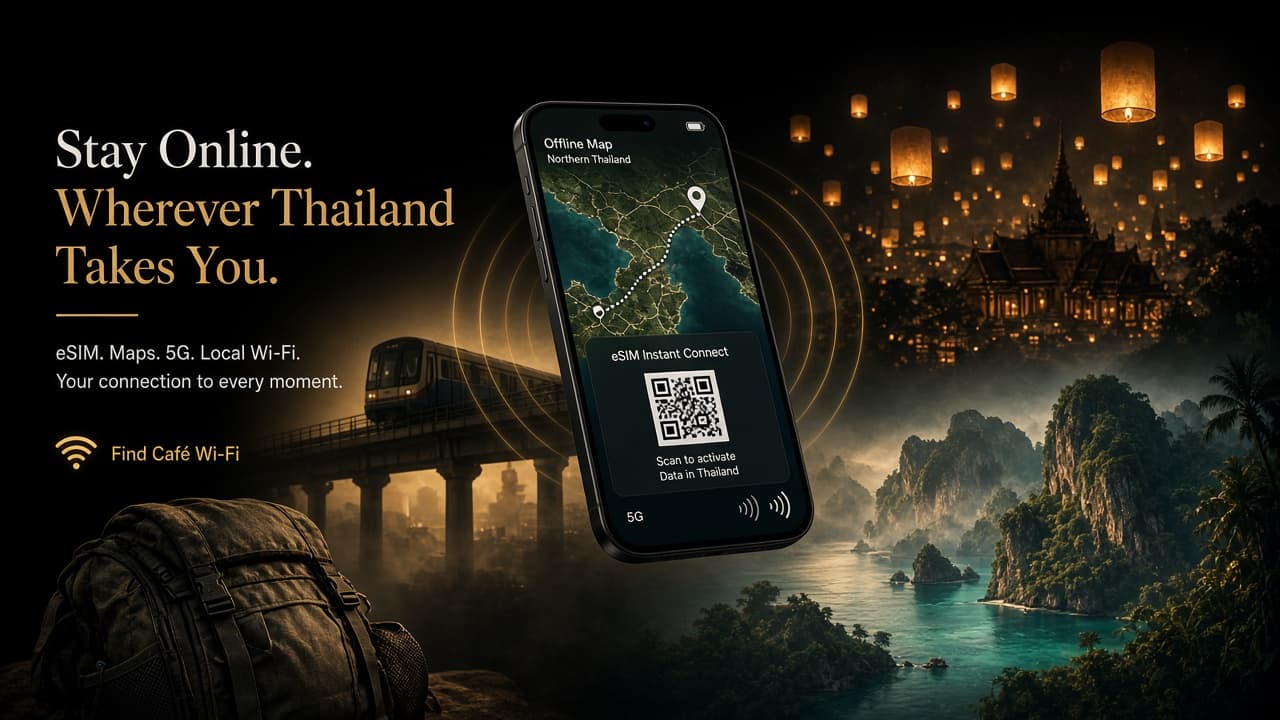
Staying online in Thailand in 2026 is no longer “find a SIM at the airport”. It is picking a ticket before Heathrow, and not flipping UK data roaming by habit.
If the phone takes eSIM, we go eSIM. Resort Wi-Fi, a tourist SIM, Pocket WiFi and a rest-of-world add-on stay on the table. They are plan A only in precise cases.
This piece does not freeze a tariff. Marketplaces, kiosks and UK carriers move. For today’s eSIMs: the Thailand comparison.
Five ways to stay online (and which is the default)
| Option | Time to online | What it wins | When it loses |
|---|---|---|---|
| Travel eSIM | Already installed | No queue, data in the taxi | Incompatible phone, need a Thai number |
| Local SIM AIS / True / dtac | Queue + passport | Local number, sometimes voice | Time, registration, nano-SIM to swap |
| Pocket WiFi | Counter or hotel | Several screens without eSIM | Deposit, charging, object to return |
| UK roaming (EE / Vodafone / Three extra-EEA) | A toggle | UK number, simple 48 h | Useful GB often too expensive after that |
| Hotel / café Wi-Fi | Password | Evening email, coworking video | Grab, street, ferry, 23:00 |
EU-style roam-like-at-home never covered Thailand, and the UK left that framework entirely. Detail: Thailand roaming 2026.
The radio is called AIS, TrueMove H or dtac. Not “Airalo” or “Holafly”. Sheet: best networks.

Saily
Network on the plan sheet
QR at home. Read AIS / True and hotspot. Sound default for backpack or city break.

Nomad
Network on the plan sheet
Tracked catalogue. No forever winner. Open it next to Airalo and Holafly.

Yesim
Network on the plan sheet
Same method: named network, duration, hotspot, checkout price after promo.
Airalo, Holafly, GigSky, GoMoWorld, Airhub, Orange Travel: we open all of them. The promo code is checked at checkout. Unlimited plans exist; so does fair use.
City break, backpack, nomad: three usages
City break 5 to 8 days. Maps, Grab, stories, bookings. Often about 1 GB a day, less if hotel Wi-Fi holds at night. Size it with the calculator. One eSIM per adult.
Backpack 2 to 4 weeks. Thailand plans are among the cheapest in Asia. Unlimited can beat a fat pack. Still read the hotspot cap. Off the corridor, AIS on the sheet.
Digital nomad, Chiang Mai or Bangkok. The bottleneck is tethering, not the logo. An “unlimited” eSIM that throttles hotspot after 500 MB is a missed Pocket WiFi. Read the hotspot guide. Two profiles (phone + tablet) often beat one fuzzy unlimited.
Install before the flight. Activation guide. Keep the UK line for 2FA.
Tool
How many GB for Thailand?
Maps, Grab, stories, video calls: a number before you buy, not an unlimited slogan.
Where internet breaks (even with a good eSIM)
Bangkok. Dense 4G/5G. BTS / MRT: it holds in stations, it drops in some tunnels. Offline maps.
Phuket, Pattaya, Krabi, Koh Samui. Solid tourist zones. Inland and quiet capes, less.
Ferries and long-tails. Radio drops mid-channel, AIS and True alike. Not an aggregator fault.
North and parks. Chiang Mai city: easy. Pai, roads, parks: AIS first if the sheet writes it.
Public Wi-Fi. Useful. Not a 2FA plan. Keep mobile data for bank texts on the UK line, eSIM for the rest.
Pocket WiFi does not create masts. It shares AIS or True. Sheet: eSIM vs Pocket WiFi. Local SIM: eSIM vs local SIM.
Checklist before you fly
- Does the phone take eSIM and is it unlocked?
- If yes: plan on the Thailand comparison, network read, hotspot read, promo pasted.
- Profile installed on Wi-Fi. eSIM data off until arrival, or follow the provider’s activation rule.
- UK data roaming off, unless the country list really includes Thailand.
- Offline maps (Bangkok, islands, north).
- Plan B only if a screen refuses eSIM: AIS / True kiosk, or a router whose listing writes the network.
We do not sell a “local secret”. We cross catalogues, grids and terms. Café Wi-Fi in Chiang Mai is a bonus. It is not a strategy.